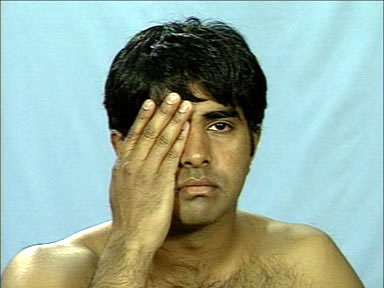
Position yourself in front of the patient.
Test the patient's visual acuity, each eye separately, covering one at a time.
Snellen's chart is used by Ophthalmologists. Visual acuity is recorded as a fraction. The numerator indicates the distance (in feet) from the chart which the subject can read the line. The denominator indicates the distance at which a normal eye can read the line. Normal vision is 20/20.
A pocket screener is used at the bedside. Hold the pocket screener at a distance of 12-14 inches. At this distance the letters are equivalent to those on Snellen's chart.
In children the techniques used are
"E" card: If the child cannot read letters or numbers
Fixation and following: In infants. Have the child follow a toy.
Pinhole test: To differentiate refraction errors from organic disease. If vision improves with pinhole it is refractory error.