Method Of Exam
| Author: A. Chandrasekhar, MD |
Consultant: E. Adams, MD
and W. Barr, MD |
Examine the Neck, Shoulder, Elbow, Wrist, Metacarpophalangeal and Interphalangeal joints. Check each joint for the following:
Inspection
- Anatomical landmarks: to identify fractures and dislocations
- for deformity
- for symmetry
- Erythema
- for signs of inflammation
- Soft tissue swelling
- Fluid in the joint
- Muscles around the joint
- For wasting
- Tear and evulsion
Palpation
- Anatomical landmarks for
- Bony prominances and contours for fractures and dislocations
- focal areas of tenderness
- Warmth for inflammation
- Joint line
- focal areas of tenderness
- for cartilagenous injuries and arthritis
- Crepatus during passive motion
- Feel for fluid in joint
- Assess synovial membrane thickness
- Musculo-tendon junctions and tendon insertions for evulsion , tear and bursitis
Range of motion
- Active
- Range for each motion
- Comparison to opposite side and yourself (assuming that you are normal)
- Observe the comfort with each motion
- Passive
- Is necessary only when there is limitation of active motion.
- If there is no limitation with passive motion, most likely the limitation in passive motion is due to neuromuscular problem and not the joint.
Neurological evaluation including sensory examination may be necessary
Palpate the joint with one hand while moving it with the other to feel for crepitation.
While examining the joints, also note any muscle atrophy.
Shoulder:
- Inspection
- Anatomical landmarks
- Head of humerus
- Bicipital grove
- Acromion process
- Subacromial area
- Corocoid process
- Sterno-clavicular joint
- Scapula
- Fluid in the joint
- Muscles around the joint
- Deltoid
- Supra and infraspinatus
- Palpation
- Check for tenderness over the biceps tendons, subdeltoid bursa, rotator cuff and acromioclavicular joint.
- Range of motion
- Shoulder motion should be examined with one hand fixing the scapula to the chest wall since 60o of shoulder motion is due to rotation of the scapula.
- Active
- The glenohumeral joint range of motion is then
- 120o abduction
- 70o adduction
- 180o Flexion
- 60o Extension
- 90o external rotation
- 90o internal rotation
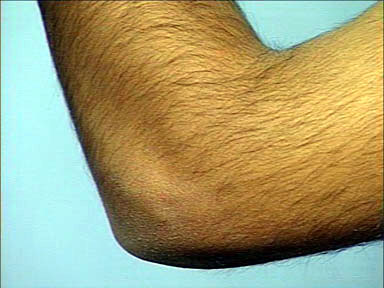
Elbow:
- Inspection
- Anatomical landmarks
- Lateral and medial epicondyles
- Olecrenon process
- Radial head
- Ulnar grove
- Carrying angle
- Muscles around the joint
- Palpation
- Anatomical landmarks for
- focal areas of tenderness of lateral and medial epicondyle' Olecrenon process
- Ulnar grove for synovial membrane thickening
- Range of motion
- Active
- Flexion: (160o)
- Extension : ( 0o)
- Pronation
- Supination
Wrist:
- Inspection
- Anatomical landmarks
- Ulnar
- Styloid process of radius
- Snuff box
- Dorsal and palmar swelling
- Muscles around the joint
- Thenar and hypothenar muscles
- Palpation
- Anatomical landmarks for
- focal areas of tenderness of Ulnar, Styloid process of radius, Snuff box for
- Range of motion
- Active
- Flexion: (90o)
- Extension: (70o).
- Radial deviation (20-30o)
- Ulnar deviation (20-30o)
Metacarpophalangeal joints
- Using the thumbs, to palpate the joint line of the metacarpo-phalangeal joints
- Check for the ability to make a full fist and extend and spread fingers.