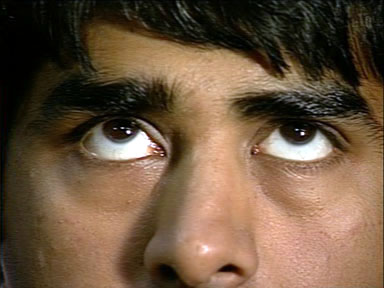
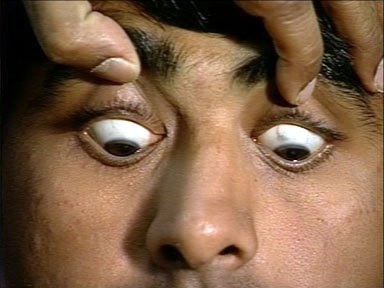
Have the patient follow an object into each of the nine cardinal fields of gaze.
Note that both eyes move together into each field.
Eye movements should be smooth and without jerking.
Eyelids should be gently lifted up by the examiner's fingers when testing downward gaze.
Jerky, oscillatory eye movements (nystagmus) may be abnormal, especially if sustained or asymmetrical.
Hirschberg light reflex test: Use a penlight in middle of field of vision. Note light reflection on both cornea. Let patient gaze in different directions, while noting the position of light reflection in cornea. If they are asymmetrical it indicated there is strabismus.
Look up how to perform cover-uncover test to evaluate non paralytic strabismus.