Method Of Exam
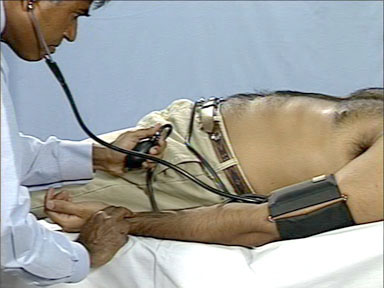
Select an appropriate size cuff .The bladder in the cuff should encircle at least half of the arm. You have to use a larger cuff in obese patients. Identify systolic blood pressure by palpatory method.
- Palpatory method:
- Empty air from the cuff and apply the cuff firmly around the patient's arm.
- Feel the radial pulse.
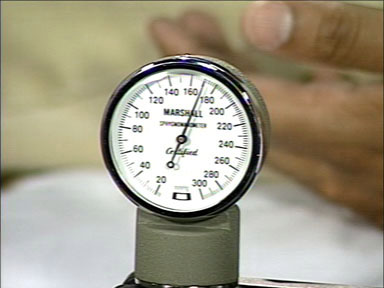
- Inflate the cuff until the radial pulse disappears.
- Inflate 30-40 mm over and release slowly until the pulse returns. That denotes systolic pressure.
- Diastolic blood pressure cannot be obtained by this method.
- Identification of systolic blood pressure by palpatory method helps one to avoid a lower systolic reading by auscultatory method if there is an auscultatory gap.
- It also minimizes the discomfort of over inflating the bladder of the cuff.
- Auscultatory method:
- Keep the bell of stethoscope over the brachial artery and inflate blood pressure cuff to a level higher than the systolic pressure determined by the palpatory method. Steadily deflate.
- Record systolic and diastolic pressures based on the Korotkoff sounds.
Record blood pressure in both arms, in supine and in standing position in the first clinical visit For subsequent evaluation use the arm with a higher reading. You need to evaluate supine and standing BP if there is suspicion for Orthostatic hypotension
If obstruction to vessels of lower trunk and limbs (coarctation of aorta, Lerich syndrome) is suspected measure BP in legs.
- Apply the cuff around thigh and place the stethoscope in popleteal fossa to listen to Korotkoff sounds.
- You may have to use a larger cuff for legs.