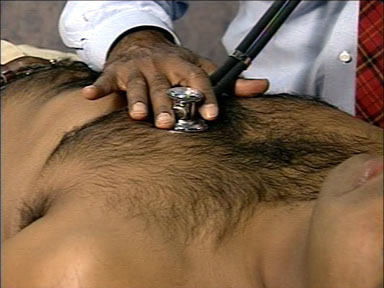
Auscultate the heart in five locations in a systemic fashion, starting at the apex, move to the lower left sternal border (include epigastrium), and extend to the base of the heart.
PMI
epigastrium
left sternal border
second right (aortic)
left (pulmonic) intercostal space
Do this once with the following:
diaphragm (which best facilitates hearing high pitched sounds including S1 and S2) and repeat with the
bell (which best facilitates hearing low pitched sounds including S3 and S4).
Give special attention to the intensity of S1 at the apex
, to the intensity of S2, and the splitting of S2 in the left second
intercostal space.
Identify any extra sounds in systole or diastole.
Listen to each cardiac event with focus on that event, excluding all other cardiac sounds, i.e., listen to S1 at all areas determining if it is split, where it is split.
If splitting changes with respiration and if it is soft or accentuated, then move and repeat for another cardiac event.
Placing the patient in the left lateral decubitus position will facilitate hearing diastolic filling sounds and mitral valve related murmers.
Normal:
S1 is louder
than S2 in apex.
S1 is softer than S2 at base.
S2 is single over apex.
S2
is normally split in base and left lower sternal border accentuated by inspiration and becomes single during expiration.