Pancreatitis
Pathology
- Pancreas is edematous and is enlarged.
- Pancreas can show extensive necrosis, acute inflammation, suppuration and or hemorrhage.
- There can be extensive peripancreatic inflammation.
- Fluid can accumulate in lesser sac and pleural space, and paracolic gutters.
- Neutrophils infiltrate the edge of the necrotic areas and extend into the adjacent lobules of fat and produce fat necrosis.
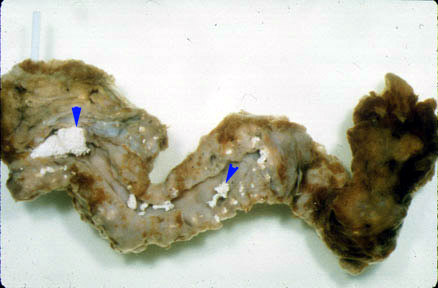
- Calcification can be seen in chronic pancreatitis.
 |
Calcification in pancreas. |
Potential complications
- Abscess/pseudocyst
- As liquefaction of necrotic pancreatic tissue progresses, it will gradually take on the appearance of localized fluid collection - pseudocyst.
- This may be in the region of the pancreas or extend beyond the pancreatic region.
- Pancreatic rupture/hemorrhage
- Obstructive jaundice
- Pulmonary complications in severely ill patients - ARDS
- GI obstruction
- Acute renal failure
What are the useful imaging procedures to evaluate patients suspected to have pancreatitis?
- Plain film is non-specific.
- CT scan is diagnostic and sensitive in the diagnosis of acute pancreatitis and its complications.
- Ultrasound is rarely used in the diagnosis of pancreatitis.
What are the imaging findings of pancreatitis in plain radiographs?
Abdominal x-ray is not diagnostic, but may show:
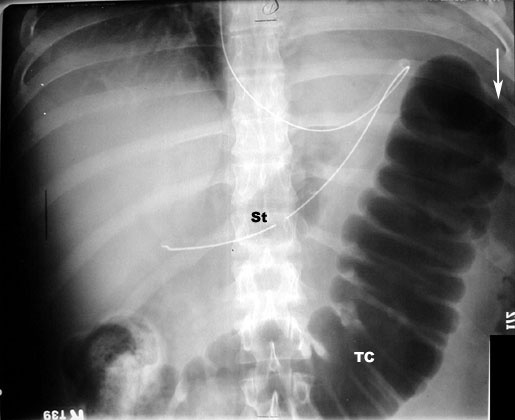
- Calcification in the pancreas
- Mass from a pseudocyst
- Ileus
- Sentinel loop: a single dilated jejunal loop in the upper abdomen
- Colon cut off: dilated colon to the mid-transverse colon with little gas seen distally. No air seen beyond the splenic flexure. This is due to extension of inflammation along mesocolon.
- Diffuse ileus most common
- Pleural effusion - left
 |
Acute Pancreatitis
Findings:
|
 |
Acute Pancreatitis
- White arrow: Colon Cut off sign
- TC: Transverse colon
- I: Ileus
|
What are the imaging findings of pancreatitis in ultrasound?
- Edematous pancreas
- Gallstones
- Dilated common bile duct
- Pseudocyst
- Due to ileus pancreas Is poorly defined in acute pancreatitis
What are the imaging findings of pancreatitis in CT?
Contrast-enhanced CT of the pancreas is diagnostic and can show:
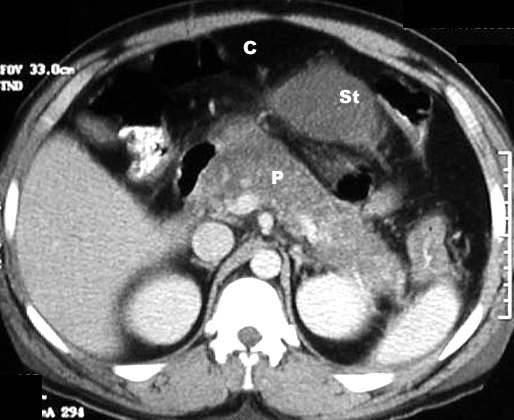
- Enlargement of pancreas due to edema
- Peripancreatic inflammation: linear strands in the peripancreatic fat
- Fluid in the paracolic gutters
- Phlegmon
- Fluid collections: A simple peripancreatic fluid collection will not have a well-defined capsule
- Necrosis: On contrast enhanced phases the necrotic pancreatic parenchyma will show decreased or no enhancement when compared with normally enhancing viable tissue
- Pseudocysts: As liquefaction of necrotic pancreatic tissue progresses it will gradually take on the appearance of localized fluid collection - pseudocyst
- Abscesses: Diffusely enlarged pancreas with air pockets
- Hemorrhagic: Enlarged pancreas with increased density due to hemorrhage
 |
Acute Pancreatitis
CT Findings:
- Diffusely enlarged pancreas with low density from edema
C: Colon
St: Stomach
P: Pancreas
|
 |
Acute Pancreatitis
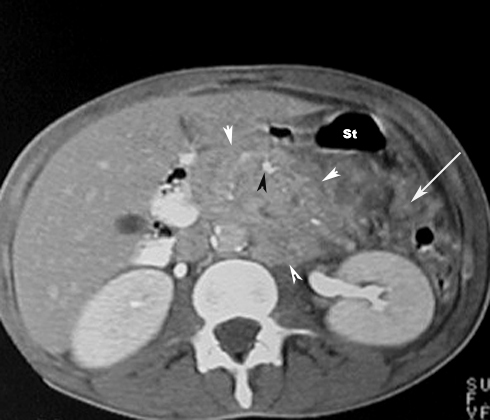
Phlegmon / Inflammatory mass
- White arrowheads: Phlegmon
- Black arrowhead: Pancreatic calcification
- Large Arrow: Peripancreatic fascial infiltration
St: Stomach
|
 |
Acute Pancreatitis / Pancreatic necrosis
- Arrow: No enhancement of pancreas with IV contrast
- Arrowheads:
St: Stomach
|
 |
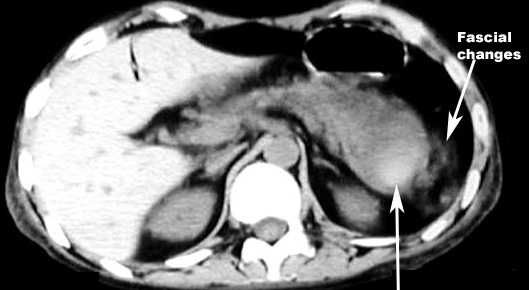
Acute Hemorrhagic pancreatitis
- Enlarged pancreas
- Increased density in the enlarged tail of pancreas due to blood
- Fascial changes
|
What are the imaging findings of chronic pancreatitis?
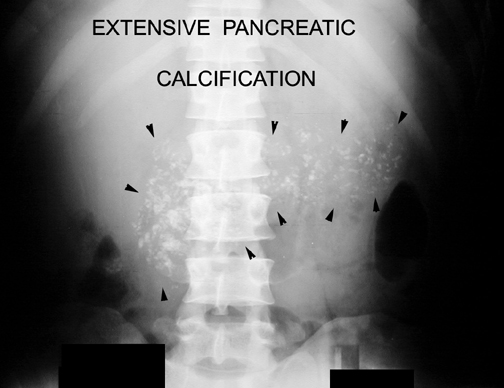
- Calcifications in the pancreas
- Pseudocysts
- As necrotic pancreatic tissue liquefies, it forms a "pseudocyst".
- This may be in the region of the pancreas or extend beyond the pancreatic region.
 |
Chronic Pancreatitis
Arrowheads point to extensive pancreatic calcification.
|
 |
Pancreatitis with Pseudocyst and calcifications
Mass density in pancreas
- White arrow: Psudocyst
- Black arrow: Calcifications
|
Which is the imaging procedure of choice in a suspected case of pancreatitis?
- If the pancreas is necrotic, CT with PO and bolus IV contrast has a sensitivity and specificity of 100 and 100%.
- For drainable collections (like a large pseudocyst), options include - CT, US
- Transabdominal ultrasound (S/S = 54/88)
- CT with PO and bolus IV contrast (S/S = 100/25)